Showing posts with label Eric. Show all posts

Sunday, November 19, 2017

Reconsidering Woody Allen

by Eric Peterson

Harvey Weinstein, Kevin Spacey, Louis C.K., Jeffrey Tambor, Brett Ratner. It seems that every day we hear about another powerful (and let's just say it -- male) figure in the entertainment industry who has been accused of sexual "misconduct" at best, and abuse/rape at worst.

While it's difficult to hear these stories -- sometimes because the stories themselves are horrendous and awful, sometimes because the men who were accused really disappointed us -- it's good that we're having this conversation, especially if it leads to real change within this industry that touches us all, whether or not it's where we spend our careers. But even if it takes us a while to make the kinds of changes that will make the worlds of film and TV a safe space for women to work and create, it's a positive development that both women and men who have been harassed or assaulted are generally being believed, and that everyone is waking up to how endemic sexual abuse really is.

With that kind of introduction, the fact that I'm about to launch into a defense of Woody Allen, of all people, might seem odd. But that's what I'm doing.

First of all, let me admit my bias. I think Woody Allen is one of the cinematic geniuses of our time. To put it simply, I'm a fan. Hannah & Her Sisters, released before the scandals I'm about to discuss, and Bullets Over Broadway, released afterwards, rate among my favorite movies made by anyone, ever. But add to that list Crimes & Misdemeanors, Interiors, Manhattan, Everything You Ever Wanted to Know About Sex (but were afraid to ask), Annie Hall, A Midsummer Night's Sex Comedy, Midnight in Paris, Match Point, September, Vicky Cristina Barcelona, Mighty Aphrodite, Radio Days, Alice, Another Woman, Broadway Danny Rose, Blue JasmineThe Purple Rose of Cairo, and more -- some of these films feel perfect in their construction and artistry, and even those with obvious flaws are still interesting, so much more interesting than what you're probably thinking about renting next. He's our generation's Chekhov -- an artist in the truest sense of the word.

None of which excuses bad behavior, of course. And while I'm busy defending the man and his legacy, let me just state for the record that Woody Allen has behaved, in my opinion, very badly.

So what exactly are we doing here? Okay, let's talk about his offscreen life for a moment, and then I'll get back to the movies.

The most serious charge against Woody Allen came from his own daughter, who was, at the time, named Dylan Farrow. She claimed that, during his separation from her mother, Mia Farrow, he molested her in an attic. Her story was, and is, harrowing. And, there's a lot of doubt surrounding the allegation. A much more detailed account of these doubts was written by Robert Weide (who produced and directed a two-part documentary about Allen's career for PBS) in The Daily Beast in 2014. You can read that essay here, but the most convincing point made, to my mind, was that the allegation was made very soon after the alleged molestation occurred, which allowed investigators to launch a thorough and timely inquiry. And they did so. And after six months of considering the evidence, including physical examinations, they concluded that Dylan had not been molested, by her father or anyone else.

What we do know for sure about Woody Allen is that he began a sexual relationship with Soon-Yi Previn, his girlfriend's adopted daughter when she was either 18 or 20 and he was 55. That is awful. No, really -- it's terrible. Moreover, it's creepy as fuck. In addition, it's a terrible thing to do to a woman you've been in a relationship with (and had children with) for twelve years. Also, it was a terrible thing for Soon-Yi to do to her mother. I totally get that. And if that makes you not want to ever watch a Woody Allen movie ever again, I will support you in that decision. But -- and this is the point -- the sordid tale of Woody and Soon-Yi is not a story about rape, or abuse, or assault, or even harassment.

At the time that they began their affair, Previn was very young, especially compared to Allen, but was, in point of fact, a few years above the age of consent -- so we can't accurately call this statutory rape. If she were to come forward today to tell the world that she had been emotionally manipulated or physically assaulted by Allen as a teenager, I'd certainly be willing to give her a hearing. But given the fact that she remains married to Allen a quarter of a century later, that's not likely.

As much as I support the #metoo movement, and I truly do -- part of supporting those who have experienced rape or abuse or assault or harassment is to 1) start by believing the alleged victim(s), 2) investigate the claims as thoroughly as possible, and 3) separate criminal behavior from that which is simply untoward or uncouth.

If you apply that measure to Woody Allen, he doesn't exactly emerge looking like a saint. But he's not a rapist. He's not an abuser. And if you still want to call for Harvey Weinstein's head one day and take in a Woody Allen movie the next, I won't call you a hypocrite.

Speaking of Woody Allen movies, did I mention how amazing they are? In them, Woody Allen -- the writer, the director, and to a lesser extent, the actor -- has an uncanny ability to see life through the eyes of so many different people, especially women. So if he can be a selfish cad, and clearly he can -- he also has the capacity for reservoirs of empathy. Like Walt Whitman, he contradicts himself, and while that's confusing and complex, it's also the most human analysis that can be offered about any of us. Witness the following scene, from Hannah & Her Sisters:


In the scene above, Hannah (Mia Farrow) meets her sisters (Dianne Weist, Barbara Hershey) for lunch. Holly (Weist, who won an Oscar for her performance) is at a professional crossroads, and has come to ask her sister for money. While she and Hannah negotiate this request, Lee (Hershey) is overcome with emotion. What the audience knows but neither Hannah nor Holly know, is that Lee is currently having an affair with Hannah's husband (Michael Caine as -- you guessed it, a selfish cad). In this scene, there are usually three or four things going on at once, dancing between what's known and what's unknown, what's practical and what exists in the darker corners of the heart. It's less than three minutes long, and it's masterful in its execution.

And there's another scene from my other favorite Allen film, Bullets Over Broadway, which came out in 1994 -- three years after Woody Allen's contentious break-up with Mia Farrow and the tabloid furor around his relationship with her daughter, that speaks directly to the question of whether or not artists should be excused for their bad behavior. I couldn't find this particular scene anywhere on the internet (do better, internet!), but the basic setup is this: David Shayne (John Cusack), an aspiring playwright, is in a conversation with Sheldon Flender (Rob Reiner), a selfish cad. Sheldon is explaining to David that artists exist on a separate moral plane than the rest of us ordinary mortals. This is probably exactly what David wants to hear, since he's cheating on his girlfriend Ellen (Mary-Louise Parker) with the leading lady of his new play (another performance by Dianne Wiest, another Best Supporting Actress Oscar), and also wrestling with the knowledge that Cheech (Chazz Palminteri), a bodyguard and the real creative genius behind David's new play, has killed Olive, the talent-deficient actress (Jennifer Tilly, who is hilarious in this movie) in an effort to save the play from being an artistic flop. However -- and this is key -- the audience hates Sheldon Flender, and we don't even know yet that he's sleeping with Ellen himself. When we hear Sheldon's philosophy from his own preening, obnoxious mouth, we reject it immediately, even after we laughed our heads off when Cheech killed Olive (no really, it's hilarious). Allen, the filmmaker, expertly makes us complicit, and then shows us the lie -- all while cramming more laughs into a single movie than he probably ever did before or since. Just to prove it, here's more genius from Dianne Wiest:


Woody Allen has a new movie coming out this winter. It's called Wonder Wheel, and it stars Kate Winslet, Justin Timberlake, Juno Temple, and Jim Belushi. I'm going to see it. I typically see whatever Winslet does, and I'm not likely to pass up a chance to see her act a script that Woody Allen has written. I might even see it in a theatre, or I might wait until I can see it at home. But I'm almost definitely going to see it.

My final diagnosis is this: Woody Allen might be a decent guy who made a big mistake. He might be a completely decent guy who found the love of his life in the oddest of places. He might be the world's most rancid asshole and deserving of nothing good in this life whatsoever. I've never met Woody Allen, and I'm not likely to. I'm not even sure I'd want to. But watching Woody Allen's movies makes me a better person. They force me to ponder life's essential questions, and they often make me laugh so hard I don't even realize I'm doing it.

Y'know, if Harvey Weinstein or Kevin Spacey never work again, I won't be upset. They have each exhibited a pattern of abusive behavior, and the stories of their victims stand up to scrutiny. It's important that they be held accountable for a history of assault, even if I, the moviegoer, miss out. There's zero chance that I'll ever see Daddy's Home 2, because I can't stand to look at Mel Gibson's face -- he's a racist, he's guilty of domestic assault, and I wouldn't enjoy watching that movie, or any movie he appears in for the rest of his career. And yet, I don't feel like I'm "boycotting" Mel Gibson. For starters, I wasn't all that likely to see Daddy's Home 2 to begin with; more importantly, I'm not trying to stop anyone else from seeing that movie. I'm personally not going, because I personally wouldn't be able to enjoy it; it's that simple.

If the public at large decided to hold Woody Allen accountable for being a selfish cad, and he stopped working after a long and prolific career, I suppose I'd survive that as well. But if Woody is still making movies (and he is), and if I, as a human being in this world, can benefit from seeing those movies (and I believe I would), then I'm going to see them. And I'm more than okay with that.

Thursday, August 10, 2017

My Current Binge

by Eric Peterson

I had a great time discussing how streaming TV is changing the way we're watching television on this week's show. We also talked about the "binges" that we've really enjoyed in the past, including my personal favorites, Jessica Jones and Happy Valley.

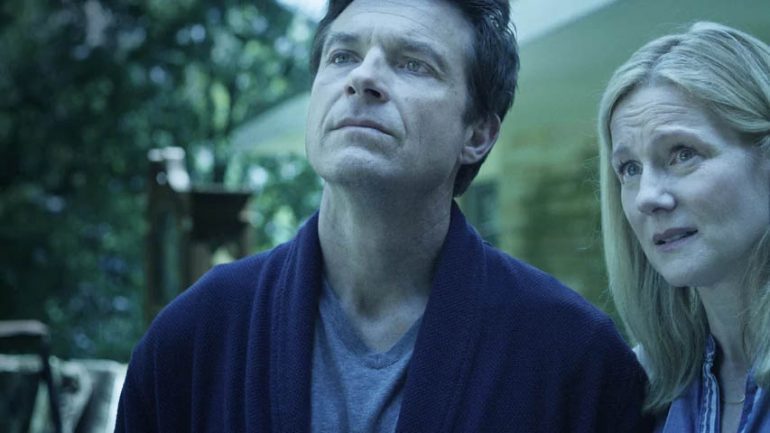
There's another show that's captured my imagination recently; we didn't talk about it on the show because when we recorded that episode, I hadn't seen it yet -- but my current binge is another Netflix show: Ozark, starring Jason Bateman and Laura Linney.

Jason Bateman & Laura Linney in "Ozark"

One reason why the show is so good is its premise -- a financial advisor from Chicago who somehow got mixed up with a Mexican drug cartel makes a deal that involves moving his entire family from their urban life to the Missouri Ozarks. If it has any legitimate ancestor in television history, its closest relative is probably HBO's The Sopranos. With a dash of Green Acres.

Like The Sopranos, it flip-flops effortlessly between crime drama and family drama, focusing much of its energy on an anti-hero patriarch who does very bad things while at the same time trying to be a good dad (he doesn't expend nearly as much effort in the husband department, but there are reasons for that). But unlike James Gandolfini, you spend the first half of the season wondering why the hell Michael Bluth is even here. And eventually, yes -- we get around to that. He's perhaps not quite so miscast as he initially appears; in fact, he's pretty darn wonderful.

And while the very first episode had me worried that the amazing Laura Linney would be simply "the wife" in a story that belonged, in every way, to her character's husband, she very quickly came into her own, playing a character that is worth an actor of her considerable talent.

Julia Garner
While I'm gushing about the cast, I also want to say one tiny word about Julia Garner as local criminal genius Ruth Langmore. When she appeared in Ozark, I thought I'd seen her before and couldn't quite place her; a quick trip to her IMDB page reminded me that she was the granddaughter to Lily Tomlin's acerbic grandmother in Grandma (a terrific little indie if you love Tomlin or sharp-tongued grandmothers or both). She's just as good here, if not better.

Like any good binge, each episode ends with a moment that makes me hunger for more. Sometimes, it's a genuine cliffhanger, other times it's just an "oh-shit" moment that nonetheless incites a viewer's curiosity; I tune in to the next episode as soon as I can because I just have to know what happens now. The final shot of the very first episode simply shows the newly relocated family standing by a lake in Missouri, surrounded by trees. The camera moves back, to reveal a puzzle of forests and lakes that's so expansive, it seems never ending. Also, you can't help but notice that the cliff they're perched on is a lot higher than you originally thought it was. A bit obvious in its symbolism, maybe -- but it served the story and worked for me, and I was immediately hooked. The second episode ended with a simple declaration of fact, spoken by Laura Linney to her two children. It's only shocking because most television mothers would have lied at this particular moment, and she doesn't. And I couldn't click on Episode 3 fast enough.

But mostly, I think this show succeeds because of a singular artistic vision. As I've just noted, it's very aware of its episodic structure -- at the same time, it feels more like a 9-hour film in ten installments than a series of 10 separate episodes about the same people. And it does things and goes places that a 2-hour film just can't. Jason Bateman probably deserves most of the credit for this; he's an executive producer on the show and directed 4 out of the 10 episodes. In addition, the show's creators (Bill Dubuque & Mark Williams) along with two other writers (Paul Kolsby and Martin Zimmerman) do the lion's share of the writing. Other writers have popped in for an episode or two, but these four were involved in scripting all 10 episodes of the first season. And that kind of consistency matters when you're telling a story about characters you think you know, only to find out three episodes later that there's a side to them you had no idea about.

If you're watching Ozark, leave a comment, here or on our Facebook page, and tell us what you think. Or, tell us what you're binging these days and why. After I finish the last couple episodes of Ozark, work my way through HBO's Big Little Lies, then polish off Season 6 of Buffy the Vampire Slayer, I might give it a look.

Thursday, July 20, 2017

That (Thirty) Million Dollar Smile

by Eric Peterson

Thirteen years ago, archeologists in Bulgaria uncovered a female skeleton that turned out to be 9,000 years old. That’s a find under any circumstances, but what made this discovery particularly extraordinary was the skeleton’s perfectly straight, perfectly shiny teeth. The scientists named their discovery “Julia Roberts.”

If right now, someone asked you to close your eyes and picture Julia Roberts, and you followed along (go ahead and try it, right now), she might have blonde hair or auburn, she might be formally or casually dressed, but chances are she’d be sporting her trademark smile – warm, generous, full of joy, existing for no other reason than that its wearer feels authentically, buoyantly happy.

Rumor has it that Julia Roberts has insured her smile for thirty million dollars, and it’s easy to see why. If something – anything – were to happen to those precious chompers, it would greatly inhibit Julia’s ability to work, or at least to get the twenty million dollar paychecks she received for some of her biggest hits.

Stacey and I recently devoted an entire show to Julia Roberts’ career, and of course we talked about the smile – that iconic moment in Pretty Woman when Richard Gere snapped a jewelry box just as she was reaching toward it, causing a spontaneous moment of laughter (you know the one), and what it feels like to be denied the smile, in a serious film like Mary Reilly.

When Owen Gleiberman at Entertainment Weekly reviewed Mary Reilly in 1996, he didn’t much care for it – using EW’s “letter grade” system, the film earned a C-minus. In his review – in the very first paragraph of his review, in fact – he writes, “Anyone eager for a glimpse of the famous Roberts smile — those luscious wax lips come to life — had better look elsewhere. In Mary Reilly, the lips are taut and nervous, drawn into a stoic line of woe. Her eyes gleam with trepidation.”

The moviegoing public didn’t much care for Mary Reilly either, or at least most of them didn’t buy a ticket. It cost $47 million to make the film, and it made only $12.3 million worldwide.

As I mentioned on the show, I remember seeing a line chart in a copy of Entertainment Weekly after the film’s release (I searched online when preparing this blog entry, but couldn’t find it) detailing the correlation between the number of times that Julia Roberts flashed her multi-million dollar smile in some of her more notable films and the amount of money each film made – and there was a direct correlation. More smiles, more money. At least in the eighties and nineties, no one was interested in a Julia Roberts that was somber or scared.

Nearly twenty years later, Julia made August: Osage County with Meryl Streep, Margo Martindale, Julianne Nicholson, Ewan McGregor, Juliette Lewis, Abigail Breslin, Benedict Cumberbatch, and more. In it, Julia doesn’t smile much either. The film didn’t break any box office records, but it did make a profit, and it fared better critically (a 64% score on “Rotten Tomatoes” compared to 26% for Mary Reilly). The world, it seems, is finally ready for a Julia Roberts that is something other than a bundle of joy – her performance as Barbara in August: Osage County is a study in a woman’s anger; in fact, it’s difficult to even call it anger; rather, she’s ROYALLY PISSED OFF in almost every scene.

Perhaps it’s because she’s no longer an ingĂ©nue. If I were optimistic, I’d suggest that perhaps our society is becoming less sexist and is finally allowing women to express emotions that might threaten or shock people. And while I’d like that to be true, I somehow doubt it. Whatever the reason, it’s entirely possible that what lies ahead for Julia Roberts the actor might be twice as exciting as what we’ve previously witnessed in the career of Julia Roberts the movie star.

And all the same, if we remember her 9,000 years from now, we’ll probably still be picturing that iconic smile. And maybe that’s okay, too.

Thursday, July 13, 2017

Sounds of Summer

by Eric Peterson

Stacey and I had a blast creating our Perfect Summer Playlist during this week’s podcast. Admittedly, we spend most of our time on the show talking about movies and TV, so we were itching to talk about pop music and this seemed like a perfect time to do it.


It occurred to me about five or six years ago that “summer music,” like holiday music (aka Christmas Carols) was a thing. But just as the B-52’s remind us that summer has a taste (specifically, “orange popsicles and lemonade”), I’ve become convinced that summer has a sound – or more accurately, lots of sounds … but sounds that particularly belong to this sunny season.

SONGS ABOUT SUMMER (duh)

The obvious place to start is songs that specifically reference summer, or where the word “summer” is right in the title. Other tunes, like Sheryl Crow’s “Soak Up the Sun” don’t quite sound right when the tulips are just beginning to pop in April or when the leaves are falling in mid-October, but couldn’t sound more perfect on a hot, July day.


SONGS ABOUT WARM PLACES

The Whole Wide World” by Wreckless Eric is a favorite summer tune of mine, probably because the first verse casually name drops both the Bahamas and Tahiti. Any song called “California Girls,” whether sung by the Beach Boys or Katy Perry (featuring Snoop Dogg) is bound to sound a little summery. I’m not sure where the Mermaid CafĂ© in Joni Mitchell’s “Carey” is supposed to be, but it’s close enough to Africa to get a hot wind, and close enough to the sea to put beach tar on Joni’s feet; it’s a classic summer tune. And even though the band is practically synonymous with Ireland, U2’s “Where TheStreets Have No Name” is so evocative of a hot desert landscape that it seems right at home on a summer playlist. “California Dreamin’” by the Mamas and the Papas is pointedly about a winter’s day, and yet it just sounds like summer.


REGGAE

The syncopated counterpoint to a bass and drum downbeat is really all it takes to send a listener on a direct route to Jamaica, home of Bob Marley, Peter Tosh, and Jimmy Cliff. The lyrics can be about injustice, intoxicants, or three little birds pitched by my doorstep – it’s bound to sound just like sunshine and a sandy beach. On the show, I picked a song by Ziggy Marley and the Melody Makers, comprised of four of Bob & Rita Marley’s children – and I like them so much, here’s another one.


LATIN MUSIC

Like reggae, songs either sung in Spanish or featuring a delicate Latin guitar can transport a listener to another land, and to a white kid from the Pacific Northwest, it often feels like the musical equivalent of a frozen margarita. My favorite new song of the summer is “Despacito,” by Luis Fonsi (featuring Daddy Yankee, not featuring Justin Bieber). In it, Fonsi sings, “Despacito/Vamo a hacerlo en una playa en Puerto Rico/Hasta que las olas griten "¡Ay, Bendito!" … which is basically an invitation to get down and dirty with Fonsi on a beach in Puerto Rico until you scream to a higher power. Yeah, I’m just going to let you ponder that for a while ... (translation: hold on a minute; Eric has the vapors).


SUMMERY ARTISTS

Anything by the Beach Boys, The Mamas & the Papas, TheGo-Go’s, or Jimmy Buffett sounds like summer. Period.


ANYTHING FROM THE SUMMERS OF YOUR YOUTH

Music has a strange ability to attach itself to memories in a powerful way. So the perfect soundtrack for your summer, no matter what Stacey and I tell you, are the songs that take you back to the summers you remember, particularly the ones that remind you of long summer vacations, for those of us lucky enough to have enjoyed those. As a child of the 80’s, that can sound like a little Toto, a little Joan Jett, a lot of Madonna, and maybe a splash of Def Leppard.


To listen to POPeration!’s “Perfect Summer Playlist,” go to Spotify or iTunes, fire up the grill, mix up some Piña Colada’s and think of us. And in the meantime, don't forget to subscribe, rate, and review. See you next week!

Friday, June 23, 2017

Eric & Stacey, sobbing in a tree; S-O-B-B-I-N-G.

For those who listened to this week's show, here are some of the moments we mentioned in our conversation. Grab your tissues.

From Terms of Endearment, here's that moment when Debra Winger says goodbye to her sons on her deathbed. Don't say we didn't warn you.


Here's the reunion scene at the end of The Color Purple that never fails to make Eric blubber. Whoopi doesn't say a word, but her reactions are enough to draw tears from a stone.


This is the final scene in David Tennant's run of Doctor Who, which turned Stacey into a blubbering mess.


Here's the moment in The Fresh Prince of Bel-Air, when Will regains, then just as quickly loses his relationship with his father.


And here's a scene from the saddest episode ever of Buffy the Vampire Slayer, when Buffy is forced to tell her young sister Dawn that their mother is dead -- featuring Sarah Michelle Gellar and Michelle Trachtenberg at their very best.


And finally, here's that Land Rover commercial that turned Stacey into a quivering mass of hormones during her first pregnancy. But honestly, can you blame her?


If you're still functioning, don't forget to hit the "Subscribe" button wherever you listen to podcasts, or maybe stroll on over to iTunes and give us a review. Every little bit of feedback helps. Thanks for listening.

Thursday, June 22, 2017

Cue the Waterworks

by Eric Peterson

There’s a great scene in Blake Edwards’ Victor/Victoria between Robert Preston and Julie Andrews. She’s at the end of her rope, both financially and emotionally, and is sobbing uncontrollably in his arms. “There have been times I’d have given my soul to cry like that,” he says. She whimpers back, “I hate it.” He smiles, pats her back, and replies, “You wouldn’t if you couldn’t do it anymore.”


There’s something about crying that presents a puzzle to anyone who studies popular culture, even as a hobby, and it is this: We tend to avoid crying in life, or at least those situations that would call forth tears. And yet, some people don’t mind, even seek out, movies or television shows that cause them to weep in response to fictional characters and situations.

In a completely unscientific bit of research earlier this week, I asked my community of Facebook friends to weigh in on the movies that never failed to make them cry, and I learned a few things – about my friends, mostly … but also about me, and why we go to the movies, period.

Several of my friends named movies they had initially seen as children. Bambi was, of course, mentioned, as well as It’s a Wonderful Life and Old Yeller, which my friend Fay goes so far as to label “abusive.” An example mentioned several times by several friends was Disney’s classic Dumbo. In particular, the moment where Dumbo’s mother, caged and branded a “mad elephant” because she wouldn’t tolerate cruelty toward her beloved child, reaching her trunk through the bars of her cage, and cradling little Dumbo in her trunk to the strains of “Baby Mine” was a significant source of trauma for many of my friends. As my friend Ellen noted, “She every mother trying to protect her son from all the hurt in the world and it can't be done.


In fact, lots of people mentioned mothers. Like Stacey, Terms of Endearment was an immediate pick for my friend Franc, for a very particular reason. “I watched it … with my mother. My sister died from cancer and viewing this movie with Mom, still so lost in her grief at the time, just gutted me. Anytime I have ever watched it since, I can't separate that memory and sense of loss from the film.

Any kind of mother seemed to elicit tears, even the gorilla mother of a human child. My friend Dennis noted that “when [Tarzan’s] mother sings, ‘You’ll Be In My Heart’ … my daughter just gets the tissues out for me.”

And of course, there’s Steel Magnolias. I told my own story in this week’s episode, but my friend Kathy sees that final scene in the cemetery from a slightly different perspective than I. “No parent can watch that scene without tears,” she says, “seeing Sally Fields try to grapple with her daughter's death.


My friend Kyle had a pick I wasn’t expecting. “As a kid, it was a VHS we had of Danielle Steele's Fine Things. It made me cry every time, mostly because it always made me think of what it would be like if I were to lose my mom.

And the dads got to join the party, too. My friend Brent (who just happens to write the best dad-blog ever) mentioned Finding Nemo, particularly the scene “at the end, where Marlin realizes he has to let Nemo grow up and experience life on his own. As a dad, I'm so not ready for that [talk].” And my friend Steve had a similar reaction at the end of Field of Dreams. “The last scene when his father says, ‘want to have a catch?’ … I start peeling onions.” My friend Leticia picked The Little Princess. “especially when she sees her father after being told that he's dead and he doesn't remember her! And then when they are finally reunited!” (She was clearly crying as she typed this.)

Familial bonds aside, stories about friendship were mentioned a lot. Beaches was a popular pick, as was Babette’s Feast. There were also some surprises in this category. My friend Erick remembers a scene from the end of Lord of the Rings: The Return of the King (and no, he wasn’t crying from sheer exhaustion, as I was). He notes, “when Sam says to Frodo on Mt. Doom, ‘I may not be able to carry the ring for you, but I can carry you,’ and hefts him up and climbs. What a heroic gesture, what an amazing friend, what an amazing bond between them.

And then there’s my friend Jeb, who teared up at the end of Guardians of the Galaxy, of all things. “Remember when the ship was crashing and Groot decided to weave his tree-like body around the group as a last-ditch biological protection? Rocket starts crying and asking Groot, his ONLY friend, ‘Why are you doing this? You'll die!’ Groot gazes into his eyes and simply says... ‘We are Groot.’ … That physical embrace and emotional union is something I cherish whenever I can find it with friends in my life, probably because I grew up in a culture that taught men not to be affectionate and not to say what is really in their hearts.


It might not surprise regular listeners to learn that there are a lot of gay men in my Facebook feed, and some of the choices reflected that as well. Latter Days, a film I’ve actually not seen, was mentioned by several friends. Jon wrote, “I really related to it and felt really lucky that I was never tortured at one of those conversion places. Never fails to get me when they are putting him in the ice bath and dunking his head under.” As pleasant as that sounds, I think I do need to see this film, given the sheer number of mentions it received.

Other LGBT films mentioned were Brokeback Mountain, Boys Don’t Cry, Freeheld, Longtime Companion, Philadelphia, and several votes for It’s My Party. “[I cry] for so many different reasons,” wrote my friend Eric. “The "what ifs: What if they hadn't broken up? What if they'd gotten back together sooner? The love story is so heartbreaking.

Finally, there were some political choices. “When Yvonne starts singing the Marseillaise [in Casablanca] and the tears run down her face, I'm right there with her,” wrote my friend Katherine.


And my friend Dan remembered the scene in Schindler’s List, “where Schindler looks at his Nazi pin and says ‘How many more could this have gotten?’” At the movies as in life, the political is often personal, too.

I admit that I had a similar experience recently, watching the national tour of The Sound of Music at Washington DC’s Kennedy Center. When the Captain got choked up halfway through “Edelweiss,” he was singing at the Kaltzberg Music Festival in front of four enormous swastikas, I could feel hot tears streaming down my face. And I wondered if I had seen this same show last year, if I would have cried. (Probably, but I did wonder.)

Other tear-inducing films that weren’t mentioned above include Avalon, A Beautiful Mind, Beauty & the Beast (2017), Big, Brian’s Song, Broadway Danny Rose, A Christmas Carol (1951), The Champ, Cinema Paradiso, Cooley High, The Deer Hunter, A Dog’s Purpose, Empire of the Sun, The English Patient, Ever After: A Cinderella Story, The Fault in Our Stars, Forrest Gump, Fried Green Tomatoes, Fur, Ghost, Greyfriars Bobby: The True Story of a Dog, Harold & Maude, Heartburn, The Hollars, How to Train Your Dragon, The Ice Storm, Imitation of Life (1959), Inside Out, Lawrence of Arabia, Life is Beautiful, Little Women (1933), Love Actually, Love Story, Madame X, Me Before You, Moana, Mulan, The Notebook, Pretty Woman, Pride & Prejudice, Rudy, A Star is Born (1954), Stepmom, Toy Story 3, The Trip to Bountiful, W;t, and The Wizard of Oz. That’s a lot of Kleenex, right there.

Sometimes we cry about things that are sad. A parent or a child (or worse yet, a dog) dies, lovers are parted, people are lonely. Sometimes we cry because the joy we feel witnessing a long overdue reunion or the birth of a child is so overwhelming that we start to leak. Sometimes we cry because people – or hobbits – are wonderful and capable of so much good that it makes our hearts swell.

But in every case, I believe, we’re not really crying at hobbits, or clownfish, or a broke Buildings & Loans manager at Christmastime, or a girl from Kansas lost on the Yellow Brick Road. We’re crying because we see something of ourselves up there. It’s probably not a coincidence that everyone in my Facebook thread who mentioned Latter Days was at one point in their lives a young gay man afraid to come out, or that everyone who mentioned Beaches was a woman who could tell me a story about her very best friend that she’s known for years. Crying at the movies is basically the same thing as looking at yourself square in the mirror and telling yourself that it’s going to be okay … or that it’s already better than okay … or maybe just that you’re not alone in the world. (Or that if the Von Trapps could smuggle seven kids over the Swiss Alps, we’ll survive Donald Trump.)

I believe that we throw ourselves up there on the silver screen whether we’re watching an action movie, a silly comedy, or a maudlin tearjerker. That’s why we’re willing to give two hours of our lives to people and situations that don’t even exist. When a movie is just okay, it lets us get away from ourselves for a little while, but when a movie is fantastic – or just the right movie at the right time – it allows us to find ourselves. 

Thursday, June 8, 2017

Who's Your Diva?

by Eric Peterson

On Tuesday, the POPeration! team kicked off Pride Month with a show all about something very precious in the LGBT community (although admittedly more important to the "G" than perhaps the other letters in our alphabet soup) ... the diva.

(L to R): Barbra Streisand, Diahann Carroll, Liza Minnelli, Rihanna, Margaret Cho, Rita Moreno, & Marilyn Monroe
On the show, I mentioned that a good icebreaker when in the company of a group of gay men you don't know is a quick round of "Who's Your Diva?" - I've done this on several occasions, with old friends and new, and it nearly always works. The reason why a particular diva has stolen the heart of the gay man in front of you nearly always makes for a great story, and the choice itself probably tells you a lot about the guy than you'll ever learn from asking him where he grew up or what he does for a living. I don't know if there's a Buzzfeed quiz about this or not, but there probably should be (in fact, there are probably several).

I should say, right off the bat, that some men refuse to play. These are typically men who have never seen a movie that was made before they were born, and when you ask them what kind of music they like, will say something non-committal like, "whatever's on the radio." We can't change these men; we can only pity them. But for the rest of us, it's a pretty fun game.

When I asked my friend Ric this question, he first scoffed at the notion of choosing only one - but when pressed, he noted that "Eartha Kitt as Catwoman nearly made me straight."


Furthermore, he said that Eartha "personified sensuality, embodied elegance but was a strong woman with simple needs who gave no fucks and maintained her principles and integrity to the end." Indeed, in her heyday, she was often known as much for her fierce activism as her iconic voice and sex appeal. It perhaps should come as no surprise that in addition to being supremely witty and a connoisseur of high fashion, Ric is also someone who follows politics fairly religiously.

My friend Andrew reports that his diva of choice is Annie Lennox. "When she was young," he says, "she had a cool, almost icy persona with which I could relate, along with a soulful vocal style that I really wanted to emulate."


"Perhaps I thought in a subconscious way that being that icy could steel me in the face of being made fun of constantly, which I was," he continued. "But actively, if I thought anything, it was that first, Annie Lennox scared me when I was 10 years old, with her mannish hair and her expressive eyes and intense lyrics like in 'Julia' and 'Somebody Told Me' and 'Love Is a Stranger.' Second, that fear electrified me, and soon I realized that I envied how free she seemed to express herself however she wanted. And third, she and the other new wave and New Romantic performers I listened to ... were a refuge from the outside world. Alone, with no one watching, I could at least carry the fantasy openly that I was as made-up, emotive and talented as they, even if I looked delusional dancing around and singing like that while alone in my room. Most importantly, I just loved her voice. I still do."

I love stories like that. Mostly, I love that when talking about their favorite divas, gay men often start to open up about some of the most vulnerable moments in their life, as Andrew did. Also, I'm reminded of how important these women are to us -- as boys, but also as men. Somehow, these stories make my endless devotion to Liza Minnelli seem less ... trivial. But more about that later.


My friend Howard came of age during the age of disco, and his immediate choice was Donna Summer. "[Those] were the days of discovering (and creating) a gay community, exploring our sexuality, and the last pre-AIDS carefree days for gay men," he said.


As a 46-year old gay man, I never got to know that world. The virus that would eventually be called AIDS was discovered when I was 11, and by the time I was in my mid-teens, AIDS was a household word. When I came out to myself and everyone else in my twenties, I had already known men who had died from the disease, and the first explorations of my own sexuality were always tinged with a fear of getting sick. If I had memories of a simpler time and a diva to embody them, I'd likely cling to that as well.

My Uncle Lee - not related by blood but by choice, agreed that Summer "
did almost literally drive us for the better part of a decade ... Disco, and especially 'The Bump' let me have virtual sex with a hundred people without the exchange of ANYTHING." At the same time, Lee's true divas of choice are singers who can touch his soul when he's on his own, in a more contemplative mood ... someone like Carmen McRae.


Like her idol, Billie Holliday, McRae was known as a "song stylist," known for her unique and poignant interpretation of every lyric she sang. Play this game with the right people, and you'll find that there's a whole world of divas beyond Madonna and Lady Gaga.

Not that there's anything wrong with Madonna. She's the go-to diva for many a gay man born on the border between Generation X and the Millennials, and that's also true for my friend Matt.


And you have to admit, Madonna's "Vogue" is a little slice of gay heaven right here on earth. Voguing was a form of dance first popularized by queer men of color in the "ball scenes" of Washington DC and Harlem. That many of her fans had no idea what Madge was singing about in 1990 when this song debuted alongside the release of the Dick Tracy film doesn't matter; her gay fans surely did -- and we loved her for it.

Michael John is another fan of Madonna. She's "someone who has reinvented herself time and time again," he notes. And I think that's important to us gay guys. Nearly all of us have felt like an ugly duckling at some point in our lives, and watching a diva try on one persona after another is perhaps proof that one day, we'll finally be a swan. Furthermore, "she unapologetically pushed the boundaries" in her music and her videos (burning crosses and a black Jesus in "Like a Prayer" come to mind). For a community that feels like our very existence often pushes the boundaries, this is -- for us -- something we admire, not something we shy away from.

Another Matt has an unusual choice for his primary diva -- unusual, that is, unless you know him well. This other Matt is a quiet sort. He'll sit around a table, still nursing his first glass of wine when everyone else is reaching for a new bottle, and he'll barely say a word ... until there's a moment of silence. Suddenly, the most devastatingly witty thing anyone's said all night will effortlessly fall from his lips. And then he'll shrug his shoulders. When I asked him who his favorite diva was, he was predictably succinct in his response. He paused, cocked his head, said "Angela Lansbury," and changed the subject.


Don't laugh. Before Mrs. Potts and Mrs. Fletcher, Lansbury was saucy in Gaslight, horrifying in The Manchurian Candidate, certifiably insane in Sweeney Todd, and every gay boy's ideal guardian angel in Jerry Herman's Mame.

As for my own diva -- I said it on the show, and a few paragraphs north of this one, and will say it to anyone who cares to listen: my gay heart forever belongs to Miss Liza Minnelli.


When I was fifteen or sixteen years old, I discovered Bob Fosse's film version of Cabaret. My father was a Navy officer, and we were stationed overseas at the time, and we had a copy of the movie on VHS. I watched it over, and over, and over again. My father admitted that my devotion to this movie worried him. I suspected that he suspected that I was gay, and I told him he had nothing to worry about. I thought I was being honest.

Part of my fascination with Cabaret had to do with Michael York's character, Brian -- and his crush on Maximillian, played by the very handsome Helmut Greig. When he confessed to a sexual relationship with Max toward the end of the film, it was a devastating moment for me, and remained so -- even after repeated viewings. But that's not what drew me to watch this particular movie again, and again, and again. That impetus was all about Sally Bowles, as portrayed by Liza.


In the film, she's heartbreaking, funny, pathetic, brassy, insecure, desperate to connect while being completely ignorant of how to do so, and driven to be nothing less than her authentic self while not having a clue who that is. In other words, she was a lot like the closeted teenager that I was when I first saw Cabaret. I maintain that it's one of the finest performances in a musical in the history of film, and it deservedly won Minnelli an Oscar in 1972 -- when I was a year old. That it spoke to me fourteen years later, and still speaks to me today, as an out gay man in my forties, is a testament to that performance.

And it's not just about that one film. In the 90's, when she was at the peak of her powers, I saw Liza perform live on three occasions, and they remain some of the most magical show biz memories of my life.


Some people (see what I did there?) see Liza as simply a parody of a gaudier time, and I credit myself with not a little bit of a maturity that these days, I don't try to convince anyone to love Liza as much as I do. Because no one really can, at least not in exactly the same way. Liza Minnelli entered my life, encased in a plastic VHS cassette, when I needed someone to really understand me, at a moment when I didn't really understand myself. And it's entirely possible that that's who Annie Lennox was to Andrew. It's likely that this is what Madonna means to Michael John and Matt no. 1, and what Angela Lansbury means to Matt no. 2. And what Cher means to Sidney, what Sara Bareilles means to Kyle, what Stevie Nicks means to Rob, what Mina means to Larry, what Diana Ross means to Lou, what Lady Gaga means to JJ, what Joan Baez means to Steve, what Barbra Streisand means to Garrick and Brett, and what Bette Midler means to Jon, and what Adele means to John.

If you've got your own answer to "Who's Your Diva," please leave it below or on our Facebook page. Because we truly can't get enough of these stories. Oh, and ... Happy Pride.